- Jun 16, 2024
Wild Mustang's First Week Home: First Touches
- Amanda Whitmire
- 0 comments
Ideally you want the horse to WANT to work together with you in harmony. I believe that having a horse that is excited to learn and wants to be with you is the ultimate freedom. Watch this "Day 0" video of bringing my first competition mustang Rocky home from the holding pens!:
Give them the time and space that they need to settle into their new surroundings. Sometimes that is a few hours, sometimes it is a few days. When you go into the pen your very first time, stand quietly with your hands at your side. Talk to your horse and look at their body, but staring at them directly in the eye or trying to move forward right away is not the best idea. Just wait to see how they react to you and work to gain their curiosity. Just feeling your presence standing inside the pen can be very nerve-racking for them. They might want to stand in the opposite corner and they might be very afraid. You might just have to start there, standing in the pen for 5-10 minute sessions until you can move forward..
Once they are settled and seemingly relaxed, try to walk a circle slowly around their pen if they’re comfortable with it and then leave some hay on the ground and walk away. You might have to do this for 5 to 10 times to build a bond with your horse. Watch my Day 1 video with Rocky. I entered his pen and he was pretty nervous with me in there, looking for an escape. We worked on circles walking, and relaxing once I stopped. At the beginning he tried to charge me once, and then he also tried to jump out of the pen once!
Eventually you want your horse walking up to you or waiting for you at the gate when you open the gate/door to catch them. You want to be able to easily hold up a halter and lead rope without them walking away or losing interest.
The ultimate goal is that they put their head down and make it easy for you to halter them. The first steps to get to that involve just bringing the halter into the space, getting them used to you, the halter and your vibration and allowing them to have the responses that they have and respecting them for that. Always leave them an opening to move their bodies away from you if they want.
It took a few weeks with my mustang Stella used to my presence. I sat with her for a long time just relaxing letting her eat with me near to get some first touches. Watch this video of my attempts:
The first week having Maverick home I did a lot of approach and retreat like this!:
Most horses like to run forward but some of them can run/hop backwards or sideways, just depending on how stressed they are. If they feel trapped they will want to freeze or run away or fight you, none of which you want. Give them their time and space and respect until they come closer to YOU. Once you can go into the pen and they’re coming up to you then you can begin the R+ process, putting the halter on their face, rubbing it on them and slowly attaching the buckles.
Here is a good video showing how I make it a bit of a game to get those first touches:
Intro to R+ (Positive Reinforcement Training)
So when I train for positive reinforcement I usually strap a fanny pack on and fill it with treats. I use Purina treats and I put about 20 to 30 treats in my pouch. I go up to the horse and allow them to meet me halfway and give them a treat making a "click" sound with my tongue right before I give them a treat. Then I hold up the halter and let them sniff it, and "click" and treat. Then I rub the halter on their face and click and treat. I do each step a few times, and not too many baby steps in one day. Patience is key.
Next, I put the halter over their nose, and click and treat. The horse should look to put their nose into the halter on their own and you can click and treat even for their excitement of wanting to be involved. Reward every try! Eventually you can click and treat for every step of putting the halter on giving the horse a boost of confidence.
Watch the video to get a great example of what it will take over several sessions to achieve getting a halter on! Take your time and be patient! But most importantly, don’t give up!!
*If the horse does not want to take treats the best "positive reinforcement" is to allow the horse to relax standing a foot or two away from you. Once you rub the halter on their nose for example you can "click" and step away and give them their space for about 20 to 30 seconds. That will give the same response as clicking and treating with a real treat. Some horses don’t like treats or certain treats or they just need more time to acclimate to taking food from you. There are a lot of videos about positive reinforcement on YouTube but for now we just are using it for haltering first, and then we will use it for other techniques down the road.
Once you halter your horse, un-halter them, give them some hay and leave them alone for awhile. Here is a good video showing a client working on haltering with her new wild mustang.
Here is where most people get stuck. Many people I have coached have had their mustang for several months, and still cannot get close enough for first touches. Are you stuck here with your mustang? Do not hesitate to reach out for support!
Friendly Game
I love the way this article HERE describes the Parelli Friendly Game and how we can use it with positive reinforcement to gain an even better connection with our horse:
"
The Parelli friendly game is essentially an exercise in desensitization, something we commonly encounter in training animals.
The basis of the Parelli Friendly Game is to show the horse that you and the equipment you use can touch the horse in a friendly manner. This means you can touch, rub and scratch the horse all over his body, not just with your hands, but also with whips, saddle blankets, plastic bags, balls, or whatever other object you come up with. This is often first taught using the Parelli carrot stick (a 4ft. rigid whip that can be used as an extension of the arm).
Some horses will easily accept being touched with novel objects. However, for many more sensitive horses, the possibility of having strange objects touch them is extremely aversive. Many horse trainers teach desensitization exercises using negative reinforcement (or even flooding). The aversive stimulus is presented slightly above the horse’s threshold. Once the horse stops moving away or begins to show signs of relaxing, the object is removed. Doing this skillfully requires a good sense of timing so that horse learns to relax and stand calmly.
However, by teaching this way, I think horse people often create horses that tolerate, rather than enjoy. These skills are almost always first taught with the horse on a lead rope and the scared horse learns he might as well put up with his human’s crazy antics. The horse is having things done to him, rather than learning how to do them or learning how to become comfortable with the process.
Using clicker training, we can help the horse be a successful learner and be actively involved in the learning process. I like teaching desensitization type exercises at liberty rather than on a lead line. Teaching at liberty is extremely empowering for the horse, as it allows him to leave if he ever feels too much pressure. The horse’s confidence increases because he has control over the situation."
Unfortunately, many horses are commonly started in training with people who "trap them, force them into squeeze chutes, tie them up, tie them down, tie up a leg, blindfold them, throw a saddle on, jam a bit in their mouth, get on and ride the buck out of them." We strive for a different approach. We introduce the Parelli "carrot stick" (or our hands, or halter/lead rope or anything really) slowly, giving the horse time to realize we are not going to hurt them.
From another article HERE, we can explain how to start the friendly game with your horse:
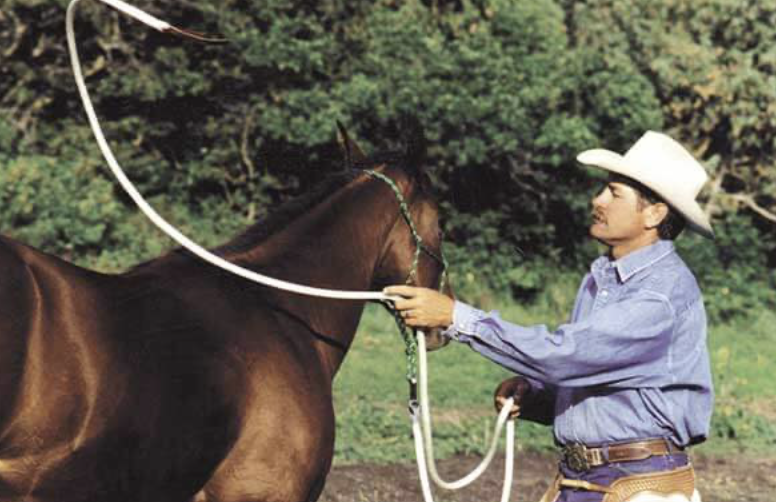
"(When wanting to work with a new horse) I have two focuses in mind: ·
I can see the finished result. I’m on the horse’s back, happy and relaxed, and the horse is happy and relaxed.
I’m going to ask for permission every step of the way, and not make assumptions. I’m going to prove to this horse beyond any shadow of a doubt that I am friendly and trustworthy.
I start by rubbing the horse in a pleasurable way wherever the horse will allow me (remember you can use your rope or your PNH Carrot Stick to every part of his body and remain safe). I begin with areas he is comfortable with and gradually move to the ones he feels more defensive about. These are the “Wait a minute! I don’t know you that well yet!” spots. I take note of those areas and use them to measure how far I’m progressing. When the horse is no longer defensive, he is telling me that he trusts his body in my hands.
From there I increase my movements to see how much the horse can stand. Some horses are okay as long as everything is slow and quiet. These are horses that people learn to sneak around. I like to do the opposite and make a lot of commotion because that technique will actually help sensitive horses from becoming scared and flighty.
I hold my horses on a loose rope, so he has plenty of room to move around while I swing ropes, skip around, jump up and down and stagger around. The horse may be upset at first but will gradually learn that he is safe while you are doing all those crazy things. The whole time I am making a commotion, I have a smile on my face with non-threatening, relaxed body language. Pretty soon the horse is convinced that I’m harmless, no matter what is going on around him. During this process a horse can get pretty upset until he figures out he is not in danger. My experience and savvy level allow me to understand when to approach, how much to approach and when to back off. To leave the horse feeling scared is just not fair so I persist through the process, approaching and retreating, until the horse becomes confident and can relax."
Once you can do this exercise with your stick or hand/rope, you can start rubbing them with other objects like tarps, flags, plastic bags, etc. You can add in more movement like jumping jacks and wavy hands while you use the objects near by or rub the horse with them. When your horse is pretty unfazed by almost anything, you know they are building confidence in you!
Check - In
Can you:
-Walk up to your horse?
-Halter your horse?
-Play the Friendly Game with your horse, rubbing all over its body?
-Rub other objects on your horse?
-Have distractions/movement near your horse?
This is the end of my free course: Mystery of the Mustang. I hope you enjoyed it and it helped you gain the confidence to adopt a wild mustang. If you need support, do not hesitate to reach out! I am here for you! You can visit my training page for a FREE groundwork checklist of the first 20 things you can do to build trust with your mustang. Check that out here> https://www.whitmirecoaching.com/training
I also provide virtual coaching if you’re ready to jump in to training! I’m excited to work with you and your horse! (All breeds welcome!)
24-Page Downloadable Guide
https://www.whitmirecoaching.com/mystery-of-the-mustang-guide
Part 1: Guide to Bringing Home Your First Horse
https://www.whitmirecoaching.com/blog/mystery-of-the-mustang
Part 2: The Ultimate Mustang Mission
https://www.whitmirecoaching.com/blog/ultimate-mustang-mission
Part 3: Inspirational Stories From Mustang Owners
https://www.whitmirecoaching.com/blog/inspirational-mustang-stories
Part 4: Options For Helping Mustangs
https://www.whitmirecoaching.com/blog/helping-mustangs
Part 5: Preparing For Mustang Adoption - What To Do (and Not Do)
https://www.whitmirecoaching.com/blog/preparing-for-mustang-adoption
Part 6: Best Shelters and Exercise Areas for Mustangs
https://www.whitmirecoaching.com/blog/mustang-shelter-exercise
Part 7: Feeding a Wild Mustang in Captivity
https://www.whitmirecoaching.com/blog/feeding-mustangs
Part 8: Bringing a Wild Mustang Home - Final Preparations
https://www.whitmirecoaching.com/blog/bringing-home-wild-mustang-horse
*Part 9: Wild Mustang's First Week Home - First Touches